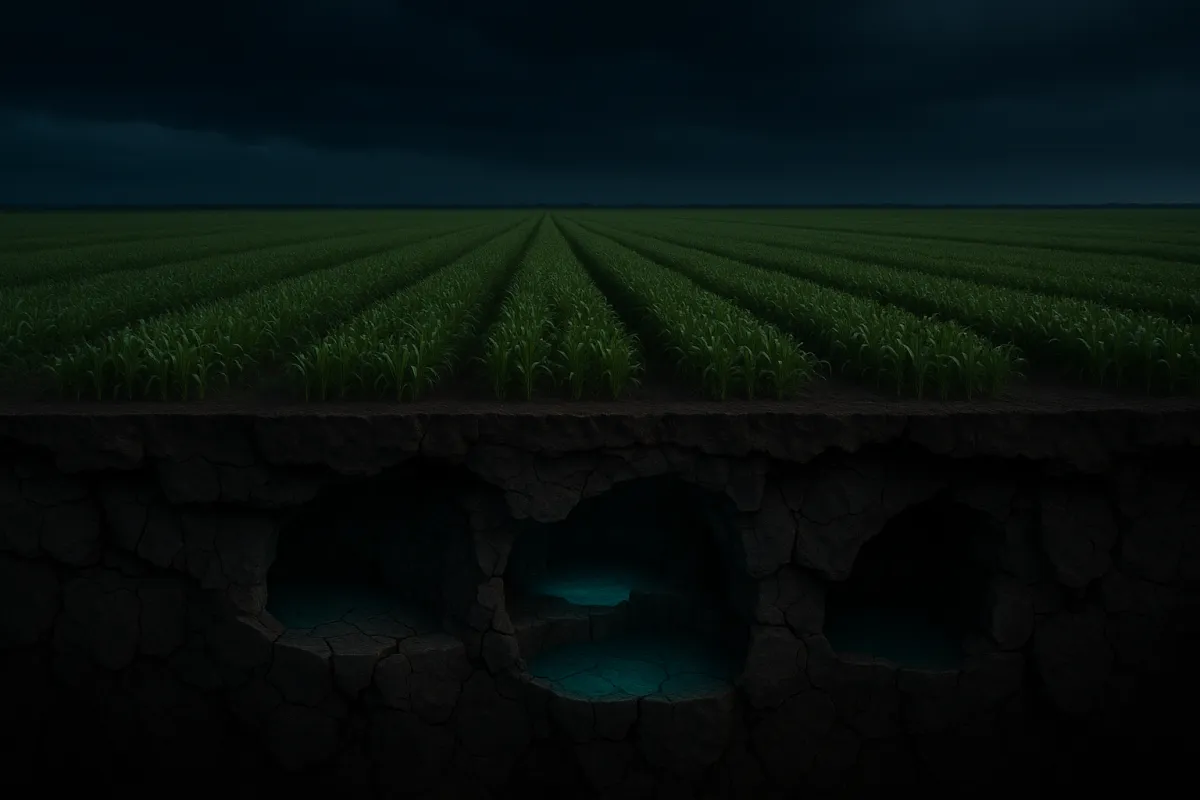
The Crisis Hiding in Plain Sight: Why Agriculture's Water Problem Never Makes the Headlines
There is a specific kind of emergency our brains are not wired to respond to.
It does not arrive with wind speeds or Richter scale readings. It does not produce satellite images of destruction or ninety-second news segments. It builds quietly, invisibly, in places most people never look — underground, in aquifers that took thousands of years to fill, and in the silent mathematics of extraction rates outpacing natural recharge.
The global freshwater crisis is that kind of emergency. And agriculture is at the center of it.
The Numbers Are Staggering. The Coverage Is Not.
The scale of the freshwater crisis is genuinely difficult to process. The United Nations estimates that 2.2 billion people currently lack access to safely managed drinking water. Four billion people — half the planet — face severe water scarcity for at least part of every year. The World Bank projects that unchecked water decline could cost the global economy trillions of dollars over the next two decades.
These are not projections from fringe researchers. These are the consensus findings of the world's most credible institutions. And yet they compete for attention with an endless scroll of louder, faster, more visually dramatic stories.
The problem with slow emergencies is that they are, by definition, slow. No single day marks the moment an aquifer crosses the point of no return. No dramatic event signals the year a farming region becomes permanently water-stressed. The crisis builds in increments too small to photograph, too gradual to trend.
By the time it becomes undeniable — when grocery prices spike, when wells run dry, when communities face impossible choices about water allocation — the window for easy intervention has already closed.
The Agriculture Equation Nobody Talks About
Here is the fact that should be leading every conversation about global water security: agriculture accounts for approximately 70 percent of all freshwater withdrawn from the planet's rivers, lakes, and aquifers. Not households. Not industry. Farming.
And of that 70 percent, research consistently estimates that 40 to 50 percent never actually reaches a crop. It evaporates from bare soil. It runs off fields. It percolates below root zones. Water withdrawn, water lost, water that produces nothing.
Work through that arithmetic and you arrive at a striking conclusion: more than a third of all the freshwater humanity pulls from the earth generates no food, no fiber, no economic return. It simply disappears into an inefficiency so vast and so normalized that we have built an entire global food system around it.
This is not a criticism of farmers, who work within the infrastructure and economics available to them. It is an observation about a system that was built for a world of water abundance — and that now operates in a world that is running a freshwater deficit it cannot afford.
The Aquifer Math Is Worse Than You Think
Underground aquifers are not wells that refill with each rain. They are geological formations that accumulated over thousands of years, filled by ancient precipitation patterns and geological processes that no longer operate at scale. When we pump them down, we are not borrowing from next season's rain. We are drawing down a non-renewable inheritance.
The Ogallala Aquifer — which stretches beneath eight states from South Dakota to Texas and underpins a significant portion of American agricultural output — is being depleted at rates that were considered alarming a decade ago and have since accelerated. Annual measurement campaigns in 2025 recorded some of the sharpest single-year declines on record in key agricultural regions of Kansas. University research published the same year projected that substantial portions of the aquifer's Texas segment could become effectively unusable within two decades if pumping continues at current rates.
The natural recharge timeline for a depleted aquifer like the Ogallala is measured not in years or decades, but in millennia. Once drawn down beyond functional levels, it does not come back on any timescale relevant to human agriculture, human civilization, or the farms that depend on it today.
The Ogallala is the most visible American example. The same pattern — extraction outpacing recharge, driven by agricultural demand and accelerated by warming temperatures — is playing out in India's Punjab, Iran's plains, Mexico's agricultural regions, and China's North Plain. This is a global phenomenon, not a regional one.
An Unexpected New Competitor
Just as the agricultural water equation was already under severe pressure, a new competitor emerged that few water policy experts had modeled a decade ago: artificial intelligence infrastructure.
A single large-scale data center can consume millions of gallons of water per day for cooling systems. As global investment in AI infrastructure accelerates — with new data center campuses being built at unprecedented pace across water-stressed regions of the American Southwest and beyond — the demands on already-stretched water systems are compounding.
The tension is real: the technology we are building to help solve efficiency problems, including agricultural water waste, itself places substantial new demands on the water systems it is meant to help protect. This is not an argument against AI development. It is an argument for doing both — computing and farming — at radically higher levels of efficiency than the current norm.
The integrated solution is the only viable one. Water saved in agriculture is water available for the data infrastructure that modern economies depend on. Water used efficiently in data centers is water available for the crops that feed the world. These are not competing priorities. They are the same priority, approached from different angles.
Why This Moment Is Different
Freshwater stress is not a new concern. Water researchers and agricultural scientists have been tracking these trends for decades. What has changed is the convergence of pressure points.
Climate patterns that once provided reliable seasonal water inputs are shifting. Population growth is placing sustained upward pressure on food demand. AI infrastructure is adding new water consumption at scale. And the aquifers and surface water systems that served as the buffer — the safety margin that allowed agriculture to absorb inefficiency — are diminishing.
The window for low-cost intervention is narrowing. The changes that would have been relatively straightforward to implement two decades ago require more urgency and more investment today. The changes that are manageable today will be far more costly, and far less effective, if deferred by another generation.
Visibility Is the First Step
The freshwater crisis stays invisible because visibility requires attention, and attention is a finite resource in an era of infinite information. But visibility is also, historically, the precursor to action. Problems that are not seen are not solved.
The goal is not to alarm — alarm without direction produces paralysis. The goal is to translate abstract global statistics into the concrete, local, solvable dimensions of a challenge that is genuinely within our capacity to address.
The water that runs through your faucet did not always flow this freely. The infrastructure, the aquifers, the water management systems that make it reliable — they are the accumulated investment of generations who built for abundance. Protecting that inheritance, and extending it to the ten billion people who will share this planet by mid-century, is the defining agricultural challenge of our time.
It is time for this crisis to become visible.
Darrin Dow explores the full scope of the global freshwater emergency — the data, the history, and the path forward — in The Last Drop: Saving Freshwater from Agriculture's Waste and the Race to Feed a Thirsty World, available on Amazon. Updated in 2025 with the latest research on aquifer decline and global water stress.